January 10, 2009

In the End, the Civilian Loses. The War Between Israel and Hamas

Photo from Amir Farshad Ebrahimi's photostream on Flickr

What do we gain by war besides terror, citizen deaths, and collateral damage? I have been following the Israeli war against Hamas. I call it the war between "Israel and Hamas", but increasingly it looks like a war by Israeli on the people of Gaza with aid workers as occasional targets. Certainly that statement is quite strong and not quite fair, but when one state enters a another states' territory to take out a non-state actor--what option do you give the civilian population living there?

As of this writing, 834 Palestinians (roughly half of them civilians and a third of the total children) have died and 13 Israelis, 11 of them soldiers. This dramatic difference is no doubt strongly linked to the differences in force used (rockets and rifles vs tanks, air strikes, and all the trappings that come with a modern army) in addition to the fact that the war is taking place in Gaza. I think we need to consider the issue of proportionality here and whether Israel is justified in using the amount of force it has used up to this point.

If you have been following the war at all, I am sure that you have heard the mention of white phosphorus over and over again. While not technically against international law, it has been traditionally used in wide-open spaces to mask the movements of tanks and large groupings of troops. Its use in Gaza is controversial because of the areas population density. Being a dumb and indiscriminate weapon, it is impossible to use it with confidence in avoiding excessive civilian and collateral damage. White phosphorous, which burns at extremely high temperatures, does not extinguish on contact with the skin. It keeps burning. Despite international outcry Israel continues to use what many might call a terror weapon.

For the last two days, Israel has agreed to a 3 hour ceasefire allowing aid to get in and citizens the chance to buy food and other essentials, but certainly 3 hours is not enough time to distribute international aid to those in need. Aid appears to be getting in, but without proper time for distribution it can have little beneficial affect.

While many things are appalling in this war (and any war), I can not ignore the fact that Israelis deserve the opportunity to live in their own land without fear of rocket attacks by Hamas. However, I continue to have faith in diplomatic options, the alternative, which we are seeing now, is simply not a humanitarian option.

In war the civilian always loses, because even when the threat of imminent death and the armies have done, they are left with the aftermath, which might be less appalling at first, but no less deadly in the end.

Quotes from recent news sources:

But the most important strategic decision the Israelis have made so far, according to senior military officers and analysts, is to approach their incursion as a war, not a police operation. Civilians are warned by leaflets, loudspeakers and telephone calls to evacuate battle areas. But troops are instructed to protect themselves first and civilians second.

Israeli infantry units are going in “heavy.” If they draw fire, they return it with heavy firepower. If they are told to reach an objective, they first call in artillery or airpower and use tank fire. Then they move, but only behind tanks and armored bulldozers, riding in armored personnel carriers, spending as little time in the open as possible.

As the commander of the army’s elite combat engineering unit, Yahalom, told the Israeli press on Wednesday: “We are very violent. We do not balk at any means to protect the lives of our soldiers.”

--New York Times, "A Gaza War Full of Traps and Trickery"


December 15, 2008

Sumo in Fukuoka


I made it to the Kyushu Basho in Fukuoka last month, and the sumo was good fun and entertaining as always. I hope to make it an annual trip. If you have the opportunity to go, do it! Even if you think it might not might be your cup of tea, it will be a great cultural experience and you'll get to see your fellow Japanese spectators in a more relaxed and jovial atmosphere. But enough reading already, watch the video. お願いします.

More Information: wikipedia or the official Grand Sumo web page here.

December 12, 2008

JLPT! Put it in the Bank


On December 7th, I took the JLPT. No horror story here, I was prepared and nothing really surprised me. Put this one in the bank baby. It was actually nice to take a test again. I've been missing the pressure that requires you to focus all your attention on one object and come as close to perfection as possible. I took level 3 this year and will most likely take level 2 next year, though it will not be the primary focus of my Japanese studies. Check the above video for a full recap plus some other footage.

December 3, 2008

Tangy & Spicy Udon

Broth:

  • Shitake Dashi (or make your own broth by throwing some shiitake mushrooms in hot water)
  • Sesame oil (a good drizzle)
  • Soy Sauce ( a glug)
  • Crushed red pepper (a good sprinkle)
  • Cayenne pepper (a good sprinkle)
  • Vinegar (a glug slightly less than that of the soy sauce)

Main dish:

  • Lettuce (spinach or your favorite variety)
  • Chicken sausage thinly sliced
  • Fresh shitake mushrooms
  • Kitsune (fried bean curd)
  • Kimchi
  • Crab (imitation is fine)

Other:

  • Udon noodles

Method:

  • Combine broth ingredients and bring to a boil
  • In another pan, combine main dish ingredients except for crab and lettuce
  • Bring another pot of water to boil, add udon noodles and let boil for 3 minutes. Rinse with cold water and set aside.
  • Add lettuce to main dish pan and allow it to wilt
  • Put noodles in serving bowl
  • Pour broth over noodles
  • Add main ingredients on top of noodles
  • Top with crab

November 29, 2008

A Sea of Lights

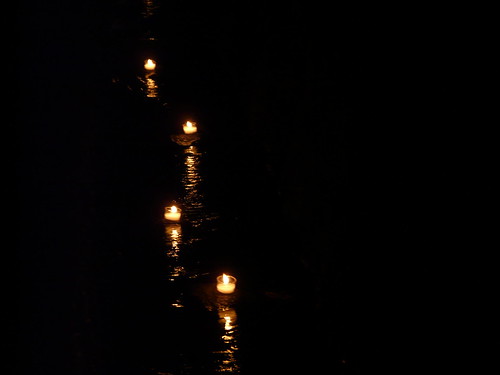
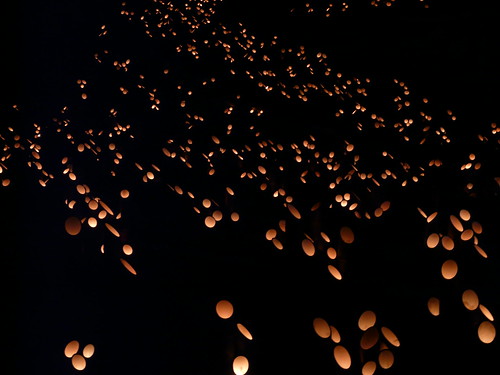
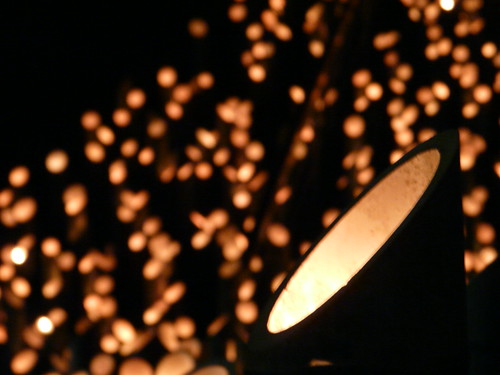
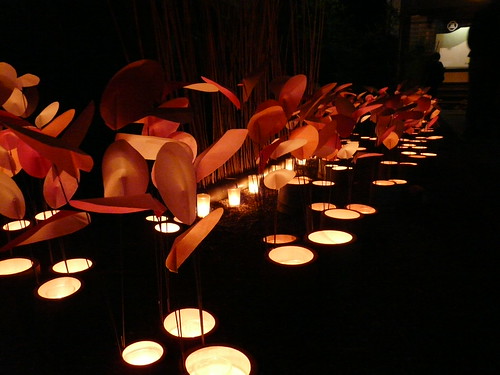
This month, I had the opportunity to attend two bamboo light festivals. One called Takeyoi Festival and the other Chikuraku Festival. This post collects a number of photos I took at Chikuraku Festival, my favorite of the two. The festivals consisted of over 10,000 bamboo stalks cut into various lenghts and bound together in numerous designs.

In areas of high concentration, one would feel a slight floating sensation as is depicted in the above and below photos.

On the various paths throughout the town that lea up to the castle and temples, bamboo candles were lined up along the steps making the stairs impassable, but the result was stunning.

Certain temples and shops added their own flair to the standard grouping of three stalks tied together. The flowers below were stunning.

Between the main groupings of candles and 'main' sights you could find groups of candles leading you to the next destination. They had their own charm too.

These two festivals were magical (幻想) and my favorite so far in Japan. I will definitely be returning each year as long as I am in the area.

November 26, 2008

Hiking in the Kuju Mountain Range


Well, it certainly is Fall here in Japan and that means I'm freezing and about to die? Yes, but that is not what I'm getting at. It means 紅葉 Fall foliage and pristine hiking. About 3 maybe 4 weeks back, when the leaves where just starting to change, I took a little road trip to the Kuju mountain range 久住山々, which is in Aso-Kuju National Park, to test my feet on its slopes.

I was not disappointed. In fact, I was floored to find out that there is hiking of this caliber in my relative area--Hiking trails of all levels are abundant, even a "marathon" park with different exercise courses (aka flat walks), quite a few summitable peaks and genuine splendid natural beauty not to mention a copious amount of onsen 温泉 to sooth those aching muscles and feet after a hard days hike. There is even a flower park くじゅう花公園. I am already planning to return and spend the night this time in one of the many ryokan 旅館 that spot the Kuju Plateau. This time I hope to climb Mt. Nakadake, which is the highest mountain in Kyusyu standing at 5870 feet/1,791m. I think this might become a regular hiking place for me. After searching around for some photos, the mountain range looks great in winter and spring too.

Here is an overhead view from Google Earth

For more info from another blogger, check out this post.

November 13, 2008

The Myth of Kagura


I had the opportunity to see kagura about three weekends back. The town which held the 5 hour performance is famous throughout Kyushu for its Kagura dances, and with good reason. It was truely amazing, and seemed like the whole town pulled together to make the event happen. I learned that a couple of my students are actually in training at the moment. But this isn't normal training, they start young at elementary school and don't preform as official dancers or music players until they are in their late teens. That is some dedication. I edited the video into the essence of the story that was told at the performance. Enjoy.

November 11, 2008

Glico Man On Acid

Ebisu Bridge, Shinsaibashi, Osaka, Japan

If you have ever been to Osaka, you have undoubtedly seen the famous Glico man shining on the canal side of Dotumbori. He is probably one of the most photographed attractions in Osaka. I managed to catch him when he thought no one was looking and dropped a tab of acid. But seriously, the lights along Dotumbori and Ebisu Bridge are not to be missed. They just finished redoing the bridge that runs over Dotumburi and added a nice space to walk and sit along the canal just below the bridge. If your feet are tired or you just want to soak up some neon, make sure you check it out.